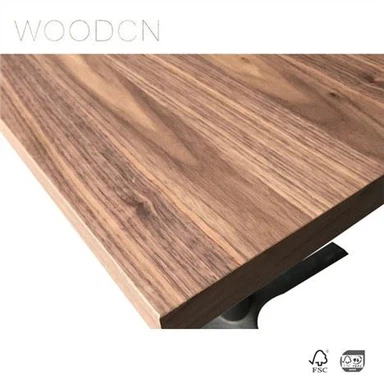
Tips for choosing the thickness of solid wood tables
Mar 22, 2025
Solid wood tables are widely popular for their natural beauty and durability. However, choosing the right thickness of solid wood tables is not only related to their appearance and stability, but also directly affects the load-bearing capacity of the tabletop. This article will explore the tips for choosing the thickness of solid wood tables to help you make an informed decision.
1. Consider the place of use
The place of use of solid wood tables is one of the important factors in choosing thickness. Different places of use have different requirements for the load-bearing capacity and stability of the table.
- Daily dining at home: For dining tables for daily use at home, a thickness of more than 2.5 cm (1 inch) would be more appropriate. Such a thickness can ensure the stability of the table without appearing too bulky.
- Commercial places: If the dining table will be used in commercial places, such as restaurants or cafes, consider choosing a thicker solid wood tabletop to increase stability and durability.
2. Consider specifications and shape
The size and shape of the tabletop are also important factors in choosing thickness. Larger and longer dining tables usually require thicker tabletops to support weight and maintain stability.
- Small dining tables: Smaller round tables may be able to get by with thinner tabletops, such as around 5 cm.
- Large dining tables: Large rectangular tables may require thicker tabletops, such as 10 cm or more.
3. Consider the material
Solid wood dining tables can be made from different woods, each with different characteristics and densities. Hardwoods with higher densities usually allow for thinner tabletops because they have higher stability. Softer woods may require thicker tabletops for added stability.
- Hardwoods: such as oak and walnut, can choose thinner tabletops, such as 6-8 cm.
- Softwoods: such as pine and fir, may require thicker tabletops, such as 10-12 cm.
4. Consider personal preferences and style
Personal preferences and style will also affect your choice of solid wood table thickness. Some people may prefer thicker tabletops because they can give a sense of solidity and stability, while others may prefer thinner tabletops because they can give a sense of lightness and modernity.
- Traditional style: You can choose a thicker desktop to show its calm and classic beauty.
- Modern minimalist style: You can choose a thinner desktop to create a clean and neat visual effect.
5. Refer to industry standards
When choosing the thickness of a solid wood table, you can refer to some industry standards and common practices. According to the search results, we can learn some common solid wood table thickness standards:
- Standard thickness: The thickness of the wooden table top is usually between 18 mm and 25 mm.
- Solid wood board table: The thickness of the board of the solid wood board table is generally between 5 cm and 25 cm, which is suitable for making office desks, large desks, etc.
- Solid wood computer desk: The panel thickness is usually around 5 cm, such as Lilunqi solid wood computer desk and Yuyan solid wood computer desk.
6. Consider the load-bearing capacity
The thickness of the solid wood table directly affects its load-bearing capacity. Thicker desktops are usually able to withstand greater weight because the thickness increases the structural stability and compressive strength of the desktop.
- 6-8 cm: Solid wood tables of this thickness are usually able to withstand heavy weight and are suitable for environments that require high stability and load-bearing capacity.
- 10 cm: This is a common thickness for solid wood slabs and is suitable for most home use.
- 5-12 cm: Thicknesses in this range are generally considered more appropriate.
7. Consider your budget
Thicker solid wood tables are usually more expensive because they require more raw materials and processing technology. Therefore, when choosing the thickness of a solid wood table, you also need to consider your budget.
- Economical: You can choose a solid wood table with a thickness between 5-8 cm, which is both economical and meets basic needs.
- High-end: You can choose a solid wood table with a thickness of more than 10-12 cm for higher stability and load-bearing capacity.
Conclusion
Choosing the right solid wood table thickness requires comprehensive consideration of multiple factors such as the place of use, specifications and shape, material, personal preferences and style, industry standards, load-bearing capacity, and budget. I hope this article will help you in choosing the thickness of a solid wood table. I wish you an ideal office or home environment!
If you have any questions or need further assistance, please feel free to consult a professional furniture designer or manufacturer.